
Hot pot is one of the easiest group meals to love and one of the easiest to book badly. The right table depends on who is coming, how much spice they can handle and what they cannot eat. These Irvine hot pot tips are a checklist to work through before you reserve, not a ranking of restaurants. We have deliberately left out names, prices and hours. Menus and policies change, and we would rather give you the questions to ask than a list that goes stale.
Work through the steps in order. Each answer narrows the field for the next one.
1. How many people are coming, and what pot format works for your group?
Short answer: Pick the pot format based on group size and how much the group agrees on flavor. The usual options are one shared pot, a split pot or one pot per person.
Hot pot restaurants tend to fall into three set-ups:
-
One shared communal pot. Everyone cooks in the same broth. This is the most social option, and it works best when the group agrees on spice level and diet.
-
A split "yin-yang" pot. The Daily Meal notes that some restaurants offer a pot divided into two halves so a group can cook in two broths at once. It suits tables where some people want spicy and others don't.
-
One pot per person. Each diner gets their own broth. This helps a lot when someone has an allergy, a strict diet or a low tolerance for heat.
Planning suggestion: When you call or check a restaurant's own site, ask which formats it offers and how it seats a party your size. A split pot shared by eight people is a different meal from the same pot shared by three.
2. Which hot pot broth should you choose?
Short answer: At Chinese hot pot, choose between very spicy mala broths and milder mushroom, vegetable or chicken broths. At Japanese hot pot, choose between the lighter shabu-shabu and the sweeter sukiyaki.
Chinese-style hot pot
According to The Daily Meal's ordering guide (Paula Beaton, Nov. 26, 2023), Sichuan (mala) and Chongqing broths are the most common, and they are very spicy. Many restaurants also offer milder mushroom or vegetable broths, and some serve a chicken broth with ginger. If your group is split on heat, this is where the split pot from step 1 helps.
Japanese-style hot pot
Tasting Table (Kat Lieu, July 6, 2023) explains the two main Japanese styles:
-
Shabu-shabu broths are "often lighter than sukiyaki broth." They are typically vegetable, chicken or kombu dashi, and ingredients are briefly swished until just cooked.
-
Sukiyaki uses a sweet warishita sauce (sugar, mirin, sake and soy sauce) over dashi, with a raw beaten egg served as a dip.
That raw-egg dip matters. Egg is one of the FDA's major allergens, so egg-allergic diners should ask before ordering sukiyaki. Anyone cautious about raw egg should ask too.
3. Is all-you-can-eat or a la carte hot pot better?
Short answer: It depends on your group's appetite and how closely you want to control the bill. Ask the restaurant how its format works before you commit, and if you order a la carte, start small.
We are not quoting any prices or time limits here, because they vary and we have not verified them for any Irvine restaurant. Here are questions to ask instead:
-
Is all-you-can-eat offered, and is there a time limit for the table?
-
How is per-person pricing handled? Does it differ for children, and does the whole table have to choose the same option?
-
Is the sauce bar included, or is it a separate charge?
-
Does the broth cost extra, and is it priced per pot or per person?
For a la carte, The Daily Meal's advice is simple: "The key to ordering hotpot is to start small." Start with a few meat trays, one vegetable tray and maybe some dumplings, then order more later so less food goes to waste. The guide also notes that menus are often paper checklists sorted by category, so it helps to decide your broth before you sit down.
4. Do you need a reservation for hot pot?
Short answer: It depends on the restaurant, so ask. Larger groups and peak dinner hours are when a reservation, or a clear answer on wait times, matters most.
We have not researched reservation policies at specific Irvine restaurants. Generic questions worth asking:
-
Do you take reservations, or is it walk-in or waitlist only?
-
Does the whole party need to be present before you seat us?
-
What are your busiest times, and is there a quieter window for a big group?
-
Can you seat a large group at one table, or will we be split across pots?
5. How do you handle allergies at hot pot?
Short answer: Know the nine major allergens and watch the sauce bar in particular. At chain restaurants in California, ask for the allergen disclosures that SB 68 now requires. At independent spots, ask staff directly.

The nine major allergens
The U.S. Food and Drug Administration lists them: "The major food allergens are milk, eggs, fish, Crustacean shellfish, tree nuts, peanuts, wheat, soybeans, and sesame." Sesame became the ninth under the FASTER Act, signed April 23, 2021, and the change took effect January 1, 2023.
Why the sauce bar deserves a second look
The Daily Meal describes hot pot sauce stations where diners build dips starting from a sesame paste base, and it names peanut sauce and sacha sauce as popular choices. Sesame and peanut are both major allergens. Shared broths can involve shellfish and fish, and as noted above, sukiyaki uses raw egg as a dip. If anyone at your table has an allergy, the dipping sauce can be as much of a concern as the broth.
What California's SB 68 means for diners
California's SB 68, the Allergen Disclosure for Dining Experiences Act, was signed October 13, 2025, and took effect July 1, 2026, according to an Arent Fox Schiff alert. The California Restaurant Association also calls July 1, 2026 the compliance deadline.
Key points from those two sources:
-
The law covers chain restaurants with 20 or more locations under the same name with substantially the same menu.
-
Covered chains must disclose the nine major allergens either on the menu next to each item or digitally, for example with a QR code linking to an online allergen menu.
-
Chains that go digital must also offer a non-digital alternative, so you can ask for one if you don't want to use your phone.
6. How do you keep hot pot safe at the table?
Short answer: Keep raw and cooked food separate, cook meat, poultry and seafood all the way through, and don't double-dip.
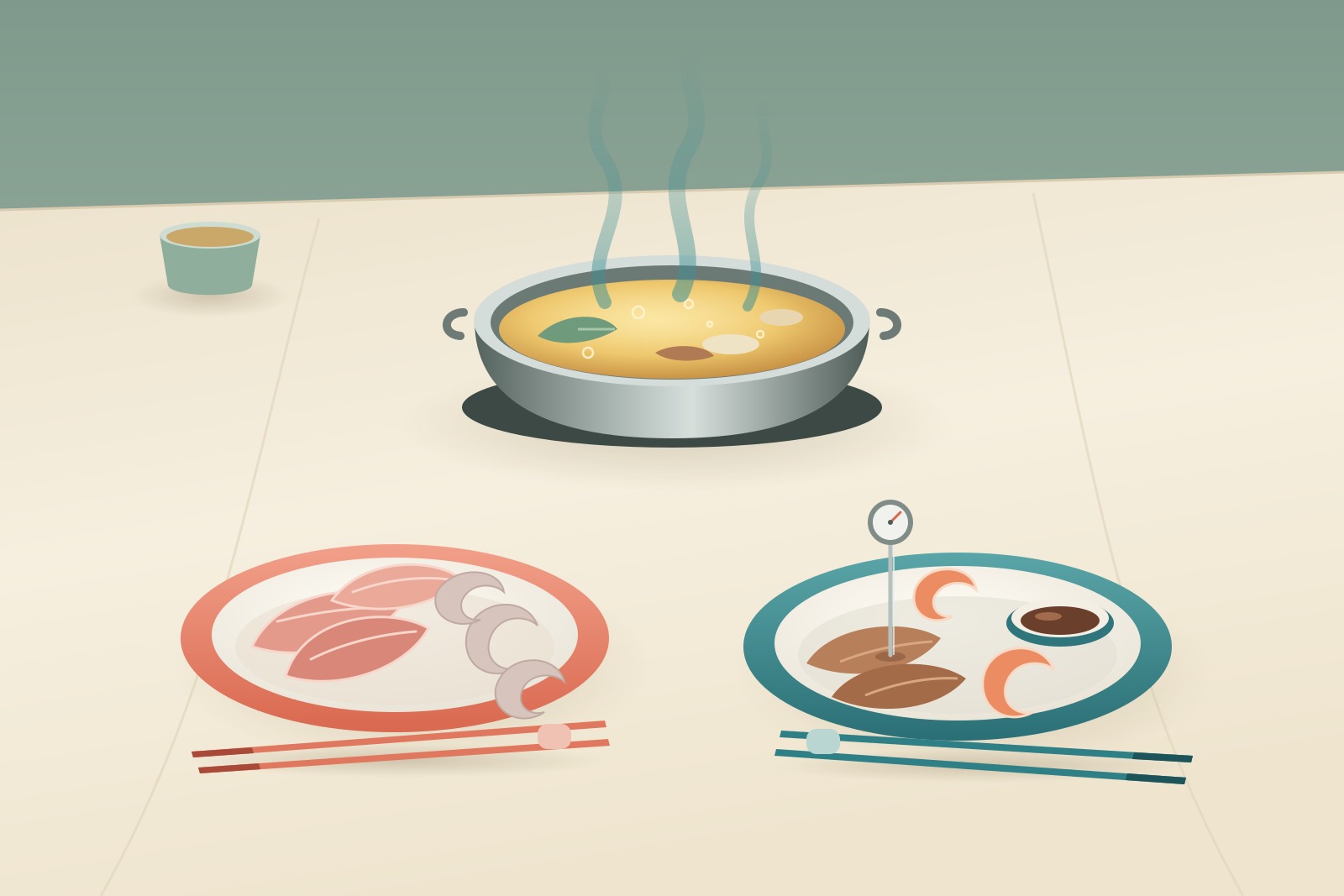
Hot pot puts raw ingredients and ready-to-eat food on the same table, so cross-contamination is the main risk. The Centers for Disease Control and Prevention warns: "Raw meat, chicken and other poultry, seafood, and eggs can spread germs to ready-to-eat food unless you keep them separate." The CDC advises using one plate for raw meat, poultry and seafood and a separate one for foods that won't be cooked.
The Daily Meal's etiquette advice makes the same point: "Don't ever use the same chopsticks for cooking raw meat as you do for eating the cooked meat." It also recommends:
-
Don't double-dip in shared sauce.
-
Add ingredients slowly to avoid splashing hot broth.
-
Put slow-cooking items like potatoes and dumplings in first, and leafy greens last.
For reference, here are the CDC's safe minimum internal temperatures:
-
Whole cuts of beef, veal, lamb and pork: 145°F, then rest 3 minutes
-
Fish with fins: 145°F, or until the flesh is opaque and separates easily with a fork
-
Ground meats: 160°F
-
All poultry: 165°F
The CDC also notes: "The only way to tell if food is safely cooked is to use a food thermometer." Most people won't bring a thermometer to dinner. In practice, give poultry, ground-meat items and seafood enough time in the boiling broth, and keep raw trays away from your eating plate. If you want to be more careful, ask for an extra set of utensils just for raw food.
7. How can you check a restaurant's health inspection record in Orange County?
Short answer: Use the Orange County Health Care Agency's Environmental Health retail food page, which lets anyone search inspection records and view a list of restaurant closures.
Restaurant inspections for Irvine, along with the rest of Orange County, appear in the county's records. The Orange County Health Care Agency's retail food page says the public can "Search for Inspection Records of any of the food establishments in Orange County." The agency also keeps a closures list giving "the reason the establishment was closed, whether it has been reopened, and the date it reopened."
Planning suggestion: Do this check before you book, especially for a big group or a special occasion. It takes a few minutes, and it works the same way whether your shortlist is in Irvine or in a neighboring city like Tustin or Costa Mesa.
The one-screen checklist
Screenshot this before you start calling around:
-
Group size: How many people, and does anyone have an allergy or strict diet?
-
Pot format: Shared pot, split yin-yang pot or one pot per person?
-
Broth: Spicy mala or Chongqing, mild mushroom, vegetable or chicken, or Japanese shabu-shabu vs. sukiyaki?
-
Ordering: All-you-can-eat (ask about time limits, per-person rules and the sauce bar) or a la carte (start small)?
-
Reservation: Do they take one, and does the whole party need to be there?
-
Allergens: Check the SB 68 allergen menu at chains, ask staff at independents and watch the sauce bar.
-
Inspection record: Look the restaurant up on the OC Health Care Agency's retail food page.
Related reading
-
San Joaquin Wildlife Sanctuary Birdwatching: How to Plan Your First Visit
-
Is Irvine Spectrum Parking Free? How to Find Free Parking Near Irvine Spectrum
Sources
-
Allergen Disclosures (SB 68), California Restaurant Association
-
The Ultimate Guide To Ordering Chinese Hotpot, The Daily Meal (Paula Beaton, Nov. 26, 2023)
-
The Difference Between Sukiyaki And Shabu-Shabu Hot Pots, Tasting Table (Kat Lieu, July 6, 2023)
-
Food Safety Prevention, Centers for Disease Control and Prevention
-
Retail Food, Orange County Health Care Agency, Environmental Health
Irvine Life is an independent publication. It is not affiliated with the City of Irvine, the University of California, Irvine, the Irvine Company or any restaurant mentioned in our sources.