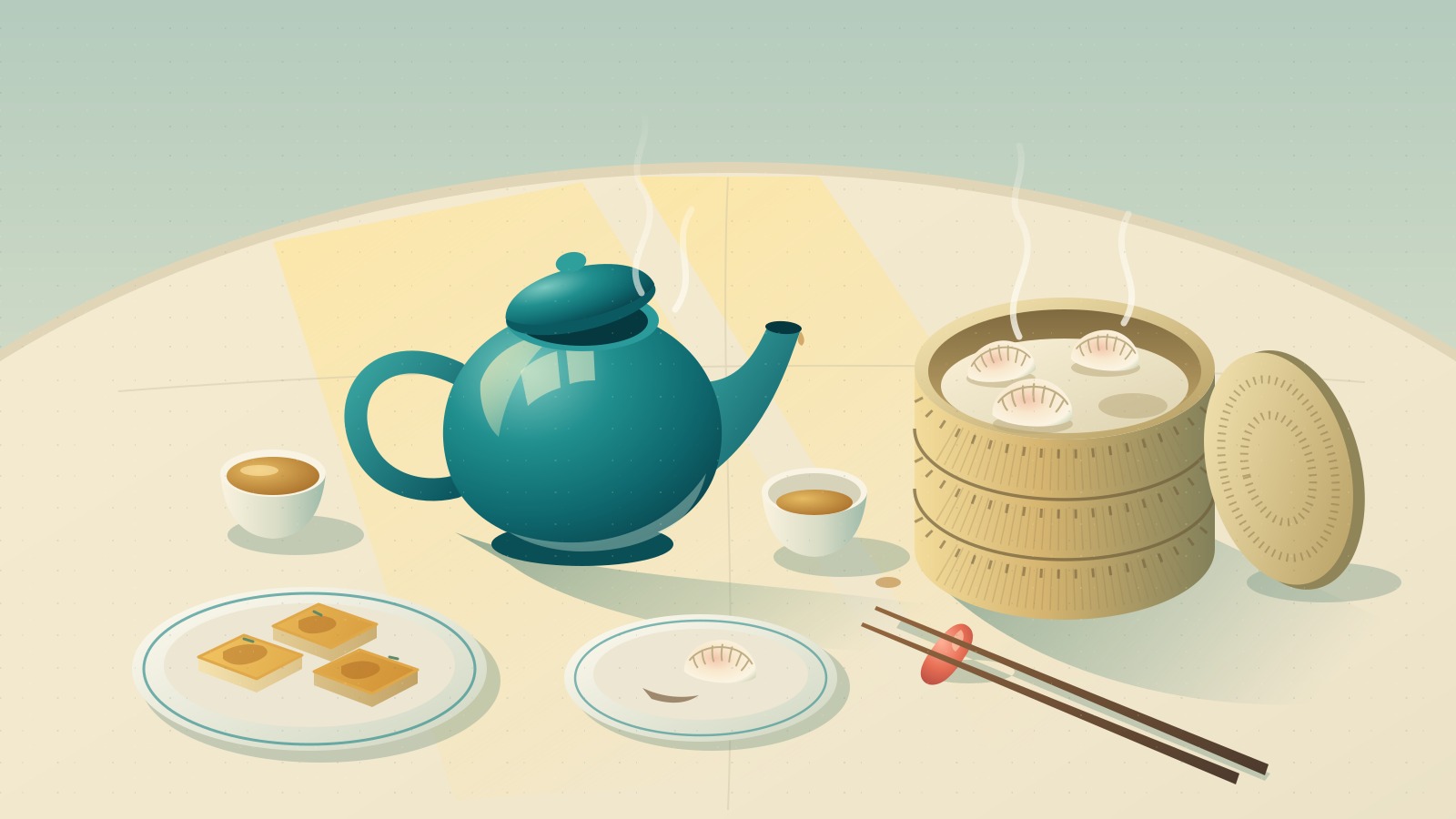
To order dim sum, pick a tea first, then find out how the restaurant takes orders. At a cart restaurant, point at what you want and the server marks your table card. With a paper sheet, mark quantities and hand it in. Order a few dishes at a time, share everything and add more if you're hungry.
-
Choose a tea. Your server will likely ask about it early.
-
Work out the format. Look for carts or a paper order sheet.
-
Order a small first round. Mix fried, steamed, bao and vegetable dishes.
-
Pour for others before yourself. Then share everything on the table.
-
Order again if you're still hungry. Dim sum has no set courses, so there's no wrong time to add a dish.
Dim sum can look intimidating from the doorway: unfamiliar dish names, a card or sheet you haven't seen before, and a table of regulars who seem to know exactly what they're doing. It's really a relaxed, shareable meal built around tea, and as Matador Network puts it, a slip-up won't get you thrown out.
Wikipedia describes dim sum as a large range of small Chinese dishes traditionally eaten in restaurants for brunch, and says the term literally translates to "touch the heart." The meal around it is yum cha, which China Highlights says literally means "drink tea" and refers to the whole spread of dishes eaten with tea. The Michelin Guide calls gathering over tea and dim sum "a daily ritual" for many Cantonese people, and gives the traditional format as "one pot, two items": a pot of tea with two varieties of dim sum. That's a useful thing to remember if a long menu feels overwhelming. The meal started small.
Know which format you're walking into
First-timers usually meet one of two systems.
Carts. Servers bring dishes around the dining room on carts, some of them steam-heated, and record what you take on a bill card with a rubber stamp or ink pen. The card stays on your table and the bill is calculated from it.
Paper sheets. Some restaurants take orders from a pre-printed sheet and serve dishes a la carte, which Wikipedia compares to tapas restaurants. Matador describes checking off boxes on a paper menu.
Paper is the format newcomers should expect. Foodism CA said in 2019, "Most spots will have you order by marking the number of items on a piece of paper." In the same piece, chef Nick Liu of Dailo said, "There are very few restaurants that do carts any more," while calling carts "more experiential than ordering from a menu."
If there are carts
-
Seat your most confident diner by the aisle. That's a tip from Seattle Magazine, drawing on Hsiao-Ching Chou.
-
Point and nod. LA Magazine's advice is that simple. If your section seems overlooked, wave gently.
-
Look after the card. It belongs on your table, since your bill depends on it. Matador says you can flag down a cart before it reaches you, and to bring your stamp card when you do.
-
Ask for what you don't see. Seattle Magazine suggests requesting any dish that isn't on the carts.
If there's a paper sheet
The main risk here is enthusiasm. Matador notes that dim sum has no courses, so it's easy to over-order, and "it's essential that you remember to pace yourself."
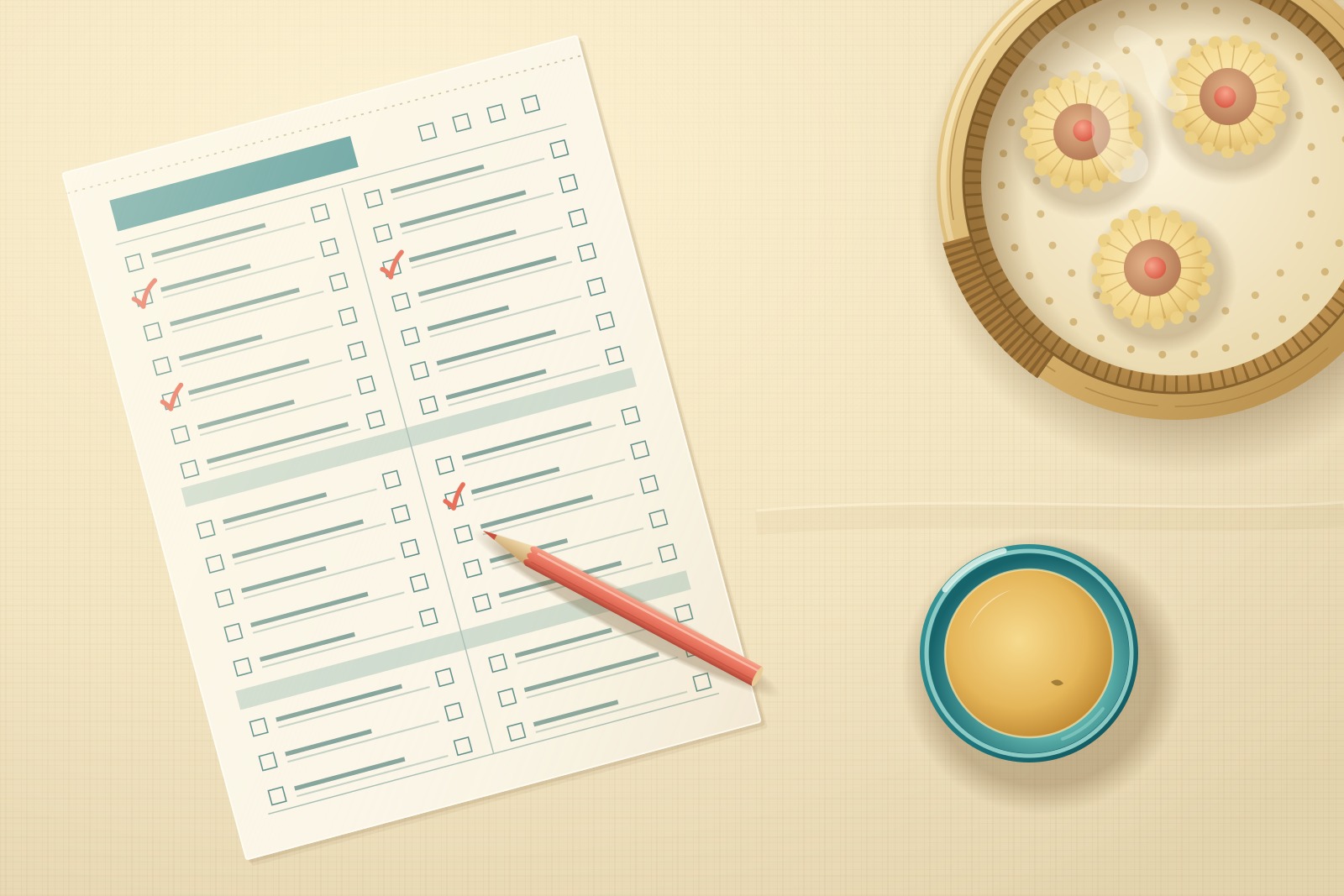
Timing matters too. In a September 2026 FoodTalkCentral thread, one diner reported that ordering many dishes at once brought food "fast and furious," so it couldn't all be eaten hot. Another said they order only a couple of dishes at a time. Those are forum anecdotes, not rules, but they make a good case for ordering in small rounds.
For balance, Anna Chen of Alma told Foodism CA to get "at least one of each type from every section," naming fried, steamed, bao and vegetables. Use that as a loose map for your first sheet.
What to order first
This starter list is our planning suggestion, not a house rule. The descriptions come from Honest Food Talks, and names and spellings can differ from one menu to the next.
-
Har gow: shrimp dumpling with a translucent wrapper.
-
Siu mai: open-topped pork and shrimp dumpling.
-
Char siu bao: bun filled with sweet barbecue pork.
-
Cheung fun: steamed rice noodle roll with fillings such as barbecue pork, beef, shrimp or scallops.
-
Lo bak gou: turnip cake, often fried.
-
Egg tart or mango pudding: an easy sweet finish.
Plain cheung fun is a vegetarian option. When you're ready to branch out, try these:
-
Fung jau: chicken feet, deep-fried, then braised and steamed until very soft.
-
Ham sui gok: deep-fried glutinous rice dumpling with pork and vegetables.
-
Wu gok: taro croquette.
-
Jeen dui: fried sesame balls with red bean or lotus seed paste.
China Highlights also lists congee and beef balls among the classics.
Tea, without the stress
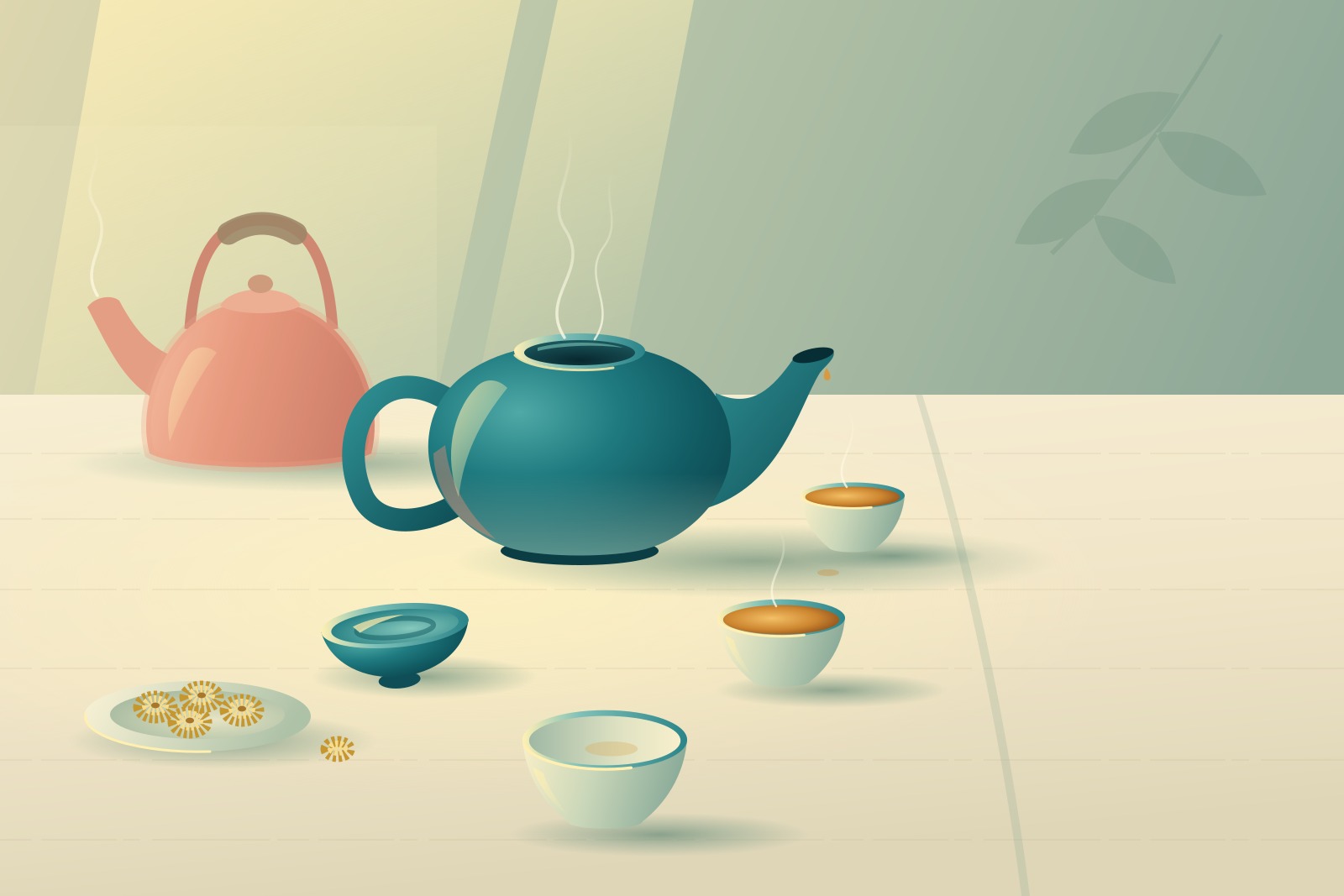
Choose it first. Matador says to order tea first, and Foodism CA says "tea is one of the first things your server will ask you about." Honest Food Talks names four to know:
-
Jasmine: mellow, and the most common at Chinese restaurants.
-
Bo lei: a bold, fermented pu'er that suits deep-fried dishes.
-
Tieguanyin: an oolong, slightly floral.
-
Chrysanthemum: subtly sweet and caffeine-free.
Pour for others first. Foodism CA says to serve everyone else before pouring your own cup. LA Magazine says to start with the eldest, and Wikipedia says the person closest to the teapot pours for the others.
Say thanks with a tap. When someone fills your cup, a light two-finger tap on the table is a quiet thank-you. The details vary: Wikipedia says two taps, Tasting Table says at least three, and LA Magazine mentions two knuckles. Don't worry about the count.
The custom comes with a good story. According to legend, told by both Tasting Table and , Emperor Qianlong was travelling incognito, and his companions tapped their fingers in place of a kowtow so they wouldn't give him away. Tasting Table also notes another theory, involving guests knocking on tables at Tang and Song dynasty banquets.
Sharing with a group
Dim sum is meant to be shared, so a few simple habits go a long way.
-
Think about piece counts. Honest Food Talks says each dish in London's Chinatown generally has 3-4 pieces. That's a rough, non-local guide, so check the plates as they arrive and order your next round accordingly.
-
Keep shared plates clean. Lady Iron Chef says it's impolite to have bits of food on your chopsticks before taking from a shared plate, or to leave chopsticks sticking out of your bowl.
-
Offer the last piece. Lady Iron Chef says to ask whether anyone wants it before you take it.
-
Signal when you're finished. LA Magazine says resting your chopsticks horizontally on your plate shows you're done.
Dim sum in Irvine
This isn't a directory or a ranking. These three Irvine, California restaurants simply show the range of what you might find, and a good first step at any of them is to phone ahead if a particular format matters to you.
Tim Ho Wan, Diamond Jamboree. This is the clearest local example of made-to-order dim sum. Korea Daily reported in February 2026 that the Irvine location reopened after a yearlong closure and renovation, with an all-day dim sum menu. Eater LA's reporting, as recapped by Briefly, says dim sum there is made to order rather than served from carts, and a March 2023 FoodTalkCentral post also said the location had no roaming carts. The chain's site lists it at 2700 Alton Pkwy, Suite 127-131, Irvine, CA 92606, with hours in late October 2026 of Sunday to Thursday, 9:30 a.m. to 9 p.m., and Friday and Saturday, 9:30 a.m. to 10 p.m. Har Gow and Baked BBQ Pork Bun are among its listed signature offerings. The restaurant first opened in Irvine in May 2019, and Briefly's recap says it was the chain's first California location.
Capital Seafood, near Irvine Spectrum. AAA gives the address as 770 Spectrum Center Dr, Irvine, CA 92618, and its listing places dim sum in the daytime. Destination Irvine's 2026 guide calls it "known for its classic dim sum and large family-style meals" and names har gow, siu mai, barbecue pork buns, rice noodle rolls and crispy shrimp rolls. An undated OCalpha review reported "there was no cart service" and said orders were placed with a pencil and checkmarks on a paper menu. Because that review has no date, treat it as a description of one past experience.
China Garden, Jeffrey Road. This restaurant, at 14825 Jeffrey Rd, Irvine, CA 92618, has been associated with carts, but reports conflict. An says carts "have returned to the dining room." A reported no carts that day and ordering from a menu, while an said "cart rotation can be pretty slow." If carts are the reason you're going, call first.
The low-pressure version
You don't need to memorize any of this. Order a little, pour for a friend, tap the table if someone pours for you, and order more if you're still hungry.
Related reading
-
Is Irvine Spectrum Parking Free? How to Find Free Parking Near Irvine Spectrum
-
Irvine villages explained: what a village is, where the idea came from, and why it matters
Sources
-
Tim Ho Wan Reopens in Irvine After Yearlong Renovation, Korea Daily, February 16, 2026
-
Tim Ho Wan, World-Famous Dim Sum Restaurant, Opens In Irvine, CBS Los Angeles, May 17, 2019
-
Best Chinese food in Irvine (2026 Guide), Destination Irvine
-
How to Have Dim Sum and Yum Cha in Hong Kong, China Highlights